
The Wild Cats of Japan:
A Fight for Survival
Cats have long been part of Japanese culture. From the rise of maneki neko (lucky cats) during the Edo period, to modern-day cat cafes, cats can be found in every corner of Japan. And yet, despite the country’s widespread love for cats, Japan’s only two native wild cats: the Tsushima leopard cat and the Iriomote cat–are on the brink of extinction.
Who Are They?
The Tsushima leopard cat and the Iriomote cat have much in common. Both are believed to have descended from leopard cats in continental Asia, but anatomical and ecological differences have led to debate over whether both are subspecies of leopard cats or if the Iriomote cat is its own species.
Both cat species are listed as critically endangered by the Japanese Red List of Endangered Species. For each, it’s thought that there are less than 100 individuals left in the wild, though robust population estimates are lacking. Tsushima leopard cats and Iriomote cats are largely solitary, elusive and are mainly crepuscular and nocturnal, meaning they are active around dawn and dusk as well as at night. This, paired with their naturally small populations, makes sightings uncommon.
Even with their many similarities, Tsushima and Iriomote cats are found in different habitats. The Tsushima leopard cat is only found on the temperate island of Tsushima. Tsushima is the largest of Nagasaki Prefecture’s islands and is almost entirely mountain forest. It is no wonder, then, that Tsushima leopard cats are great climbers, preferring to rest in trees and hide in dense undergrowth.
The Iriomote cat is only found on the tiny subtropical isle of Iriomote, one of the southernmost islands in the Japanese Archipelago. Iriomote is 284 km2 and was recently designated as part of a UNESCO natural World Heritage site. Iriomote cats are found throughout the island but prefer to remain in lowland coastal areas, where much of the island’s human development is.
Both Tsushima and Iriomote cats eat small mammals such as mice, moles, and rabbits, and also tend to hunt along streams, wetlands, paddies, and coastal shallows for small fish and crabs. Tsushima leopard cats mainly prey on small rodents and only seasonally supplement their diets with other food sources.
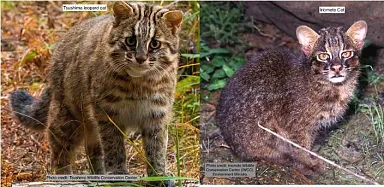
Because both Tsushima and Iriomote cats weigh approximately 3-5 kilograms (6-11 pounds) and closely resemble domestic cats. It is important to recognize their particular characteristics and understand how they differ from our domesticated feline companions. Doing so can help prevent accidental human-wildlife interactions.
Dwindling Populations and the Road to Recovery
Why are these wild cats endangered? Their restricted geographical ranges make them particularly vulnerable to natural disasters, disease outbreaks, and genetic problems, which can have devastating consequences for the entire population. In addition, habitat loss caused by urban development and deforestation, roadkill incidents, and declines in prey populations jeopardize these already scarce felines. Infectious diseases from domestic cats, such as feline immunodeficiency virus, pose another serious threat.
The Japanese Ministry of Environment has been spearheading conservation efforts for these two wild cats with the hope that, in the future, they will be able to live safely and thrive in their respective environments. Breeding programs have been established in zoos across Japan, and camera traps have been deployed across Tsushima and Iriomote to document animal presence.
Outreach by local organizations is also helping to raise awareness around these cats. This includes campaigns to prevent vehicle collisions associated with the rise of tourism due to the recent UNESCO designation.
Sources
Baskin, C. Iriomote Cat Facts. Big Cat Rescue. https://bigcatrescue.org/conservation-news/iriomote-cat-facts
Ito, H. et al. 2020. Genetic diversity and genetic structure of the wild Tsushima leopard cat from genome-wide analysis. Animals, 10(8): 1375.
IUCN/SSC Cat Specialist Group. 2024. Living Species - Leopard Cat. https://www.catsg.org/living-species-leopardcat
Izawa, M., Doi, T., Nakanishi, N. and Teranishi, A., 2009. Ecology and conservation of two endangered subspecies of the leopard cat (Prionailurus bengalensis) on Japanese islands. Biological Conservation, 142(9):1884-1890.
Ministry of the Environment, Government of Japan. no date. State of Japan’s environment at a glance: Extinct and endangered species listed in the Red Data Book. https://www.env.go.jp/en/nature/biodiv/reddata.html
Mussies, M., 2026. Insular divergence and taxonomic status in the leopard cat lineage (Prionailurus): A comparative analysis of the Iriomote population. Journal of Entomology and Zoology Studies.
Nishimura, Y., et al. 1999. Interspecies transmission of feline immunodeficiency virus from the domestic cat to the Tsushima cat (Felis bengalensis euptilura) in the wild. Journal of Virology, 73(9): 7916-7921.
Tsushima Wildlife Conservation Center. no date. Partnerships with zoos. https://torayama-twcc.jp/english/outsidearea/
Tsushima Wildlife Conservation Center. no date. What is a Tsushima leopard cat? https://www.torayama-twcc.jp/tsushimacat/
UNESCO. Amami-Oshima Island, Tokunoshima Island, Northern part of Okinawa Island, and Iriomote Island. https://whc.unesco.org/en/list/1574/
Do You Have 2-4 Hours A Month To Preserve Your Local Ecosystem?
Our volunteers are the driving force behind making true change in ecosystem health and wild cat conservation. Some like to volunteer in the field, others help us maintain our online presence, and some work with events. With just a few hours a month, you can make a difference, too.
Make A Difference Right Now
As a 501(c)3 nonprofit, our work is only possible because of generous donors like you.
More than 93% of your donation will go directly to our groundbreaking research, outreach, and education programs.
This is where true change starts. If you’d like to be a part of it, make a donation to Felidae Conservation Fund today:
Or,