
The Hidden Toll of Rodenticides Poisoning Pumas and Bobcats
If there is one fundamental truth about chemical poisons, it is that they never stay where we put them. They leach through soil, wash into waterways, and bioaccumulate up the food chain. More than six decades ago, Rachel Carson’s Silent Spring sounded a national alarm on how DDT, a persistent organochlorine insecticide, was devastating wild bird populations far beyond its intended agricultural targets. A decade after her warning, the Environmental Protection Agency (EPA) banned domestic use of DDT, later designating it a probable human carcinogen (EPA 2025).
Today, a parallel ecological crisis is unfolding - not from insecticides, but from chemical rodent control. While managing rodent populations has long been a priority for public health and agriculture, our widespread reliance on anticoagulant rodenticides (ARs) has introduced a grave threat to non-target wildlife.
Anticoagulant rodenticides work by blocking blood clotting, causing targeted rodents to bleed to death internally over several days. Second-generation anticoagulant rodenticides (SGARs) are engineered to be far more lethal and persistent, lingering in liver and muscle tissue long after ingestion. Because an affected rodent takes days to die, it becomes slow, disoriented, and easy prey for predators. When mesocarnivores and apex predators - such as owls, hawks, coyotes, foxes, bears, bobcats, and pumas - consume these toxic rodents, the poison enters the wider food web with devastating results.
Exposure to ARs causes severe sub-lethal impacts, including compromised body condition (Elmeros et al. 2011), altered foraging behavior, suppressed immune response, and heightened susceptibility to debilitating parasites and sarcoptic mange (Riley et al. 2007; Serieys et al. 2015; NPS 2017). Every year, direct and secondary poisonings kill dozens of species across North America, including threatened bald eagles and California condors. Even when exposure does not cause immediate mortality, persistent chemical loads disrupt organ systems, immune health, and reproductive capability. Domestic pets are frequently poisoned as well, and the human toll remains significant: according to the National Poison Data System, thousands of young children accidentally ingest anticoagulant rodenticides every year (Beuhler et al. 2025).
The Acute Impact on Pumas and Bobcats
Researchers increasingly point to rodenticide exposure as a key driver in local carnivore population declines, urging wildlife managers to prioritize chemical contamination as a major conservation threat (Keating et al. 2024).
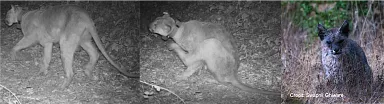
For wild felids like pumas (mountain lions) and bobcats, exposure to rodenticides is shockingly pervasive. In California, necropsies conducted by the California Department of Fish and Wildlife (CDFW) on wild felids killed by vehicle strikes or poaching between 2014 and 2018 revealed that over 90% of mountain lions and 88% of bobcats tested positive for rodenticide exposure. Earlier liver tissue analyses showed contamination rates as high as 94% in California lions (Rudd et al. 2018).
Perhaps most alarming is the impact on fetal development. In a landmark study examining eight necropsied pregnant mountain lions across California, all eight mothers showed evidence of two or more AR compounds in their systems. Furthermore, nine full-term fetuses showed direct transplacental exposure to rodenticides, including bromethalin—a potent neurotoxic rodenticide (Rudd et al. 2024). This confirms that mountain lion kittens are being exposed to toxic neurotoxins and anticoagulants before they are even born.
This is not isolated to California. In Washington state, research revealed that 68% of tested pumas and bobcats carried detectable AR loads, pointing to widespread, chronic contamination across the Pacific Northwest (Tovovich et al. 2024).
Legislative Progress, Persistent Loopholes, and Ecosystem Contamination
Recognizing the threat to native predators, California passed landmark legislation in 2020 restricting many SGAR uses (Messenger-Sikes & Quinn 2020). In 2024, the state expanded these protections with Assembly Bill 2552 (the Poison-Free Wildlife Act), extending restrictions on first-generation ARs (FGARs) and SGARs in designated wildlife habitats (California State Legislature 2024; Center for Biological Diversity 2024). Following California's lead, states like Maine and Rhode Island enacted strict statewide outdoor residential restrictions, while legislatures in New York, Washington, Massachusetts, and Colorado are considering similar bans (Lawrence 2026; Maine Legislature 2025).
While these legislative milestones represent major progress, translating policy into clean ecosystems has proven difficult. Expansive exemptions for commercial agricultural operations, structural pest control, public health interventions, and critical infrastructure allow massive quantities of poison to remain in circulation.
As a result, wildlife contamination remains critically high. The most recent statewide survey from CDFW found SGAR compounds in 95% of tested mountain lions - including Los Angeles’s famous urban puma, P-22, as well as 83% of tested bald eagles and 69% of general non-target wildlife (CDFW 2025). The poisons have even leached into aquatic food webs, with river otters testing positive for rodenticide residues. The message is clear: legal bans with wide exemptions are insufficient to curb environmental poisoning.
Smarter Alternatives: Integrated Pest Management and Biological Control
Ending non-target wildlife mortality requires shifting away from chemical dependency toward Integrated Pest Management (IPM). IPM focuses on long-term prevention through structural sanitation, rodent-proofing, waste management, and physical trapping. For example, recent research confirms that reducing accessible organic waste in peri-urban environments significantly decreases rat activity without chemical intervention (Shukla & Wilmers 2024).
Biological control offers another powerful, self-sustaining solution. Apex aerial predators like barn owls, hawks, and eagles are far more efficient at suppressing rodent populations than chemical baits. A multi-year pilot study by the Ventura County Watershed Protection District demonstrated that deploying barn owls for levee protection cost just $0.26 per rodent controlled, compared to $8.11 per rodent using traditional trapping and poison methods (Ventura County 2017; Raptors are the Solution).
Emerging technologies also offer promising non-lethal management options. Rodent contraceptives (such as ContraPest) disrupt reproductive structures and significantly reduce targeted populations within months (Ray & Pyzyna 2022; Jacoblinnert et al. 2024). While the long-term non-target effects of fertility controls require continued monitoring, they present a far safer mechanism than persistent bioaccumulative toxins.

How You Can Help
Protecting pumas, bobcats, and native ecosystems requires action at both individual and community levels:
- Adopt Poison-Free Practices: Eliminate rodenticide baits at home. Focus on exclusion by sealing cracks larger than a quarter-inch, securing trash containers, and trimming dense ground cover.
- Advocate Locally: Encourage your local municipal government, school district, or neighborhood association to adopt formal poison-free management resolutions, following the lead of communities like Malibu, California.
- Utilize Educational Resources: Explore detailed guides on non-toxic pest control from leading conservation organizations:
- SafeRodentControl.org
- Raptors Are The Solution (RATS)
- National Park Service: Living with Wildlife
- Northwest Center for Alternatives to Pesticides (NCAP)
- University of Florida IFAS Extension Rodent Management Guide

Sources
Beuhler, M. C., et al. (2025). 2024 annual report of the National Poison Data System® (NPDS) from America’s Poison Centers®: 42nd annual report. Clinical Toxicology, 63(12), 1029–1280.
California Department of Fish and Wildlife. (2025). The 2024 Summary of Pesticide Exposures & Mortalities in Non-target Wildlife. Report prepared by the California Department of Fish and Wildlife, Wildlife Health Laboratory, Rancho Cordova, CA, USA.
California State Legislature. (2024). Assembly Bill No. 2552: Pesticides: anticoagulant rodenticides (2023–2024 Reg. Sess.). https://calmatters.digitaldemocracy.org/bills/ca_202320240ab2552
Center for Biological Diversity. (2024, September 25). California OKs strongest rat poison restrictions in nation. https://biologicaldiversity.org/w/news/press-releases/california-oks-strongest-rat-poison-restrictions-in-nation-2024-09-25/
Center for Biological Diversity. Safe Rodent Control: Living Rodent Free While Safeguarding Wildlife, Families, and Pets. https://www.biologicaldiversity.org/campaigns/Safe-Rodent-Control/
Elmeros, M., et al. (2011). Concentrations of anticoagulant rodenticides in stoats Mustela erminea and weasels Mustela nivalis from Denmark. Science of the total environment, 409(12): 2373-2378.
Jacoblinnert, K., et al. (2024). Effects of an Anti-Fertility Product on Reproductive Structures of Common Vole Males and Residues of Compounds. Biology, 13(6): 450.
Keating, M., et al. (2024). The role of anticoagulant rodenticides in global carnivore declines. Conservation Biology, 38(3): e14210.
Lawrence, A. (2026, June 22). Homeowners say goodbye to "best tool available" for rat infestations as US state passes strict ban. The U.S. Sun. https://www.the-sun.com/news/16554467/new-rat-poison-ban-law-rhode-island/
Maine Legislature. (2025). Resolve, directing the Board of Pesticides Control to prohibit the use of rodenticides in outdoor residential settings (LD 356). https://legislature.maine.gov/legis/bills/display_ps.asp?LD=356&snum=132
Messenger-Sikes, B., & Quinn, N. M. (2020, December 10). California places further restrictions on rodenticides. UC Agriculture and Natural Resources. https://ucanr.edu/blog/pests-urban-landscape/article/california-places-further-restrictions-rodenticides
National Park Service. (2017, October). Researchers investigate link between rodenticides and mange in bobcats. U.S. Department of the Interior. https://www.nps.gov/articles/researchers-investigate-rodenticides-and-mange-in-bobcats.htm
Raptors Are The Solution. Benefits of Raptors. https://raptorsarethesolution.org/the-benefits-of-raptors/
Ray, C. N., & Pyzyna, B. (2022). Controlling roof rats on poultry farms using ContraPest, a contraceptive bait. Proceedings of the Vertebrate Pest Conference, 30, Article 16.
Riley, S.P., et al, (2007). Anticoagulant exposure and notoedric mange in bobcats and mountain lions in urban southern California. The Journal of Wildlife Management, 71(6): 1874-1884.
Rudd, J. L., et al. (2018). Anticoagulant rodenticide exposure in mountain lions (Puma concolor) in California. California Fish and Wildlife Journal, 104(2), 65–81.
Rudd, J.L., et al. (2024). Detection of Rodenticides in Pregnant Mountain Lions (Puma concolor) and Their Fetuses in California. Canadian Wildlife Biology and Management, 13, pp.50-63.
Serieys, L. E., et al. (2015). Anticoagulant rodenticides in urban bobcats: exposure rates, disease susceptibility, and population impacts. Ecotoxicology, 24: 801–815.
Shukla, I., & Wilmers, C. C. (2024). Waste reduction decreases rat activity from peri-urban environment. PLoS ONE, 19: e0308917.
U.S. Environmental Protection Agency. (2025, September 11). DDT: A brief history and status. https://www.epa.gov/ingredients-used-pesticide-products/ddt-brief-history-and-status
U.S. Environmental Protection Agency. (2025, September 16). Restrictions on rodenticide products. https://www.epa.gov/rodenticides/restrictions-rodenticide-products
Ventura County Public Works Agency Watershed Protection District. (2017, December). Raptor Pilot Study for Levee Protection: Integrated Pest Management Program. https://vcportal.venturacounty.gov/BOS/District2/RaptorPilotStudy.pdf
Yovovich, A., et al. (2024). Wild Felid Anticoagulant Rodenticide Exposure in Washington. Journal of Wildlife Diseases, 60: 311–320.
Do You Have 2-4 Hours A Month To Preserve Your Local Ecosystem?
Our volunteers are the driving force behind making true change in ecosystem health and wild cat conservation. Some like to volunteer in the field, others help us maintain our online presence, and some work with events. With just a few hours a month, you can make a difference, too.
Make A Difference Right Now
As a 501(c)3 nonprofit, our work is only possible because of generous donors like you.
More than 93% of your donation will go directly to our groundbreaking research, outreach, and education programs.
This is where true change starts. If you’d like to be a part of it, make a donation to Felidae Conservation Fund today:
Or,