How America is Redesigning Its Roads for Wildlife
Whenever a new housing development breaks ground, a familiar question surfaces:, how can growing human populations coexist with wildlife?
Fortunately, the conversation is shifting. Rather than debating if large carnivores like pumas belong on the landscape, we are finally asking how we can share space. As urban sprawl fragments natural habitats, isolation has become a primary threat to top predators. But history has taught us that we need them. When West Coast kelp forests collapsed without sea otters, or Yellowstone’s rivers degraded without gray wolves, we learned that apex predators keep ecosystems healthy, regulating everything from prey populations to disease, soil nutrients, and forest health.
But how do you avoid turning wild habitats into isolated islands surrounded by concrete?
The Super-Predator Factor
As it turns out, pumas are already doing their part to avoid us. Research by Felidae shows that pumas actively alter their behavior to dodge light, noise, and human activity. To a puma, humans are a super predator, a major risk to be avoided at all costs. Like most wild animals, pumas don’t like being near humans.
Consider Hollywood’s famous mountain lion, P-22. He lived for a decade in Los Angeles’ Griffith Park, surviving entirely on local deer while surrounded by millions of people, proving that pumas can quietly adapt to the edges of our world.
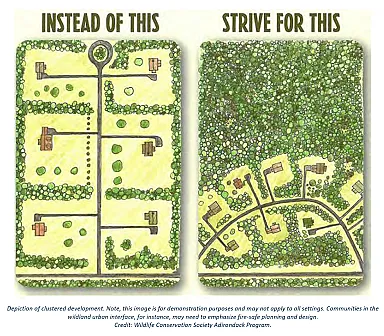
Luckily, some regions are successfully pioneering strategies, even in some of the country's fastest-growing cities. The expansion of housing development into wildlife habitat changes the way pumas use the landscape and forward-thinking planners are taking note. This means prioritizing ecological connectivity, which is the degree to which a landscape facilitates or impedes the movement of animals, plants, and water. Measures include creating wildlife corridors, keeping development open and spacious, and setting up buffers around sensitive habitats like streams.
Local Communities Leading the Way
While some states have passed sweeping conservation laws, like Minnesota’s Buffer Law, which requires counties to enforce riparian vegetation buffers along lakes and streams, the most exciting innovation is happening at the local county and city level. A recent report by the Center for Large Landscape Conservation outlines how towns are successfully weaving wildlife protection into local zoning:
- Maricopa County, Arizona: Two of the state’s fastest-growing cities have preemptively designed master plans that protect natural drainages and wildlife corridors right alongside massive new housing developments.
- Eagle Mountain City, Utah: In 2021, this rapidly developing area established Utah’s first Mule Deer Migration Corridor. By restricting development and installing educational signage, the city originally sought to reduce wildlife-vehicle collisions, but ultimately created a win for broader open-space planning.
Benefits to city-level co-planning for open space and sustainability include centered growth to reduce travel time, walkable communities, improved air quality, water conservation, and reduced negative wildlife-human interactions. In fact, in 2025, the Center for Large Landscape Conservation found that many smart development strategies appeal across the political spectrum, as ecological connectivity planning also yielded cost savings, raised property values, prevented urban sprawl, and supported climate resilience planning.
Preventing wildlife-vehicle collisions
Even with smart zoning, major highways remain a deadly obstacle for animals with large home ranges. Roads, particularly multilane highways, can isolate animal populations, leading to inbreeding, reduced fitness, and desperate, often fatal attempts to cross these concrete gauntlets.
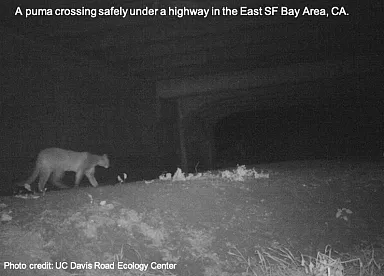
An estimated 7,000 large wildlife-vehicle collisions occur each year in California alone, costing the state more than $230 million annually, and up to $500 million if you include collisions reported to insurance companies but not reported to the California Highway Patrol. To address these collisions, wildlife crossings have become one of the most effective tools for reconnecting fragmented habitats.
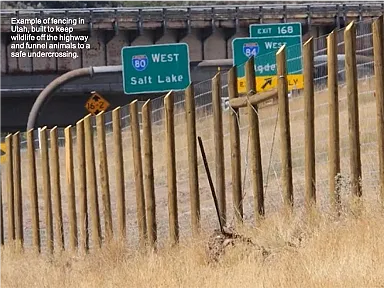
While California already has 100 wildlife crossings, there are still plenty of collision hotspots where new crossings or fencing remain critical. That includes the soon-to-be world’s largest wildlife crossing. the Wallis-Annenberg Wildlife Crossing north of Los Angeles. Currently being built over eight lanes of the busy 101 freeway, it features two miles of specialized fencing.
Projects like this highlight that overpasses and underpasses are not a one-size-fits-all strategy. Context matters. For example, along the San Francisco Bay Area peninsula, there is almost no suitable puma habitat east of Interstate 280. In cases like this, heavy-duty fencing is actually the smarter choice to prevent dangerous crossings altogether, rather than funnelling animals into urban zones.
The 2025 Connectivity Report details dozens of these successful efforts, both massive and modest, across states like Arizona, Colorado, North Carolina, Virginia, Florida, Utah, Vermont, and Wyoming. Over the next decade, the Wallis-Annenberg crossing and projects like it across the country will do more that just cut down on roadkill; they will allow wildlife to move between habitats without wandering into residential neighborhoods,.
Ultimately, housing development and pumas do not have to be mutually exclusive. These strategies for human-puma coexistence shouldn’t be viewed as sacrifices communities have to make to accommodate wildlife. Instead, neighborhoods across the U.S. are discovering that investing in these solutions brings unexpected lifestyle, economic, and climate resilience benefits, creating a genuine win-win for people and the wild alike.
References
Granados, A., et al. 2026. Illuminated landscapes: urbanization’s influence on predator and prey behavior. Urban Ecosystems, 29: 82.
Minnesota Board of Water and Soil Resources. 2026. Minnesota Buffer Law. https://bwsr.state.mn.us/minnesota-buffer-law
National Park Service (NPS). (2023, June 13). Puma profiles: P-22. U.S. Department of the Interior. https://www.nps.gov/articles/000/puma-profiles-p-22.htm
National Wildlife Federation. 2026. Wallis-Annenberg Wildlife Crossing: About the project. https://101wildlifecrossing.org/about-the-project/
Paul, K. and A. Breuer. 2025. Integrating Wildlife Habitat Connectivity into Local Government Planning: Examples, Recommendations, and Resources for U.S. Towns and Counties. Center for Large Landscape Conservation. https://doi.org/10.53847/GLYQ9718.
Ripple, W.J., et al. 2014. Status and ecological effects of the world’s largest carnivores. Science 343: 151.
Road Ecology Center. (2024). Hotspots report 2024: Roadkill, a preventable natural disaster. University of California, Davis. https://roadecology.ucdavis.edu/resources/roadkill-preventable-natural-disaster
Smith, J.A., et al. 2017. Fear of the human ‘super predator’reduces feeding time in large carnivores. Proceedings of the Royal Society B: Biological Sciences, 284: 20170433.
Stoner, D.C. et al. 2023. Stepping stones to extirpation: Puma patch occupancy thresholds in an urban‐wildland matrix. Ecology and Evolution, 13: e10381.
Taylor, P. D., et al. 1993. Connectivity is a vital element of landscape structure. Oikos 68:571-573. https://carleton.ca/glel/wp-content/uploads/Taylor_et_al_1993-Connectivity-is-a-vital-element-of-landscape-structure.pdf
Wildlife Society. 2021, October 25). JWM: Big cats adapt to city life. https://wildlife.org/jwm-big-cats-adapt-to-city-life/
Do You Have 2-4 Hours A Month To Preserve Your Local Ecosystem?
Our volunteers are the driving force behind making true change in ecosystem health and wild cat conservation. Some like to volunteer in the field, others help us maintain our online presence, and some work with events. With just a few hours a month, you can make a difference, too.
Make A Difference Right Now
As a 501(c)3 nonprofit, our work is only possible because of generous donors like you.
More than 93% of your donation will go directly to our groundbreaking research, outreach, and education programs.
This is where true change starts. If you’d like to be a part of it, make a donation to Felidae Conservation Fund today:
Or,