
Unexpected Findings on Patagonia’s Coast:
Small Wild Cats Among the Penguins?
- Author: Mauro Lucherini
- Publication Date: October 29, 2026
- Related Project: Patagonia Wild Cats Project
- Focus Species: Leopardus geoffroyi (Geoffroy’s Cat) , Puma concolor (Mountain Lion) , Leopardus colocolo (Pampas Cat)
In Islote Lobos National Park, the Patagonian scrubland runs straight into the Atlantic, creating a landscape where wildlife thrives. Along its pristine shores, food is plentiful: seabird chicks and sea lion carcasses offer easy meals for land-dwelling carnivores.
After decades of absence due to human persecution, pumas have returned to parts of the Patagonian coast, sparking new interactions between predators and prey. In several coastal areas, pumas have been recorded hunting Magellanic penguins, even adjusting their movements and behavior to make the most of the nesting season. But what does this seasonal bounty mean for Patagonia’s smaller wild cats? Until now, no one knew.
The Patagonia Cats Project is working to learn more about the two elusive small cats that share Patagonia’s drylands, the Geoffroy’s cat and the Pajeros cat, and to begin addressing the threats to their survival. Our surveys so far show that both species are generally uncommon, and in some places we haven’t found them at all, raising real concerns for their conservation.
During our latest field campaign, we deployed camera traps in Islote Lobos National Park, a protected area on the Atlantic coast of northeastern Patagonia that had never been surveyed for these cats.
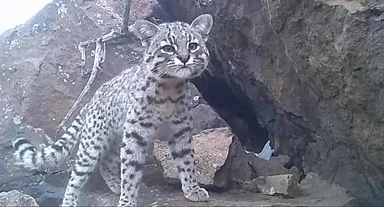
What we found surprised us. On a sandy beach lay the fresh carcass of a small wild cat, with a second small cat skull nearby. A few kilometers away, we discovered a large latrine of fresh felid scat inside a rocky shelter, less than 100 meters from colonies of Magellanic penguins and terns.
Naturally, we set up a camera trap at the shelter’s entrance. Our investigation is now underway, and we hope the footage will soon help us understand these novel relationships between small wild cats and marine wildlife. Stay tuned for updates in a future issue!
Do You Have 2-4 Hours A Month To Preserve Your Local Ecosystem?
Our volunteers are the driving force behind making true change in ecosystem health and wild cat conservation. Some like to volunteer in the field, others help us maintain our online presence, and some work with events. With just a few hours a month, you can make a difference, too.
Make A Difference Right Now
As a 501(c)3 nonprofit, our work is only possible because of generous donors like you.
More than 93% of your donation will go directly to our groundbreaking research, outreach, and education programs.
This is where true change starts. If you’d like to be a part of it, make a donation to Felidae Conservation Fund today:
Or,