The Unexpected Social Ripple of Local Wildlife Science
There is a distinct thrill that comes with checking a wildlife camera trap or finding a critical piece of data on a forest trail. Sorting through images to suddenly spot a mountain lion slinking through the shadows, catching a bobcat moving gracefully through the brush, or collecting a biological sample on a weekend hike alters a person's perspective. In that exact moment, a resident transforms. They are no longer just someone who happens to live near wild country; they become an active researcher and a steward of the ecosystem.
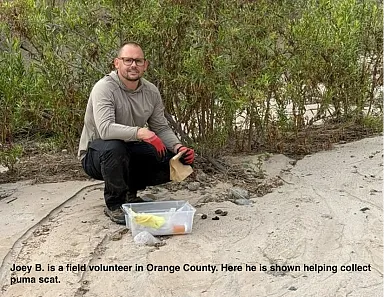
At the Felidae Conservation Fund, our research depends heavily on these moments. Through initiatives like the Bay Area Puma Project and the Bay Area Bobcat Project, everyday community members are placing cameras, logging sightings, and analyzing data. Meanwhile, volunteers with our Wild Cat Health Project are hitting the trails to participate in scat surveys, collecting the vital biological data needed to understand the genetic health, disease exposure, and diets of these elusive predators.
In social psychology, this personal transformation is rooted in Social Identity Theory, which explains how group membership and shared values directly shape an individual’s environmental attitudes and collective actions (1). Research indicates that active involvement in hands-on conservation efforts enhances a volunteer's internal sense of identity, triggering a positive "behavioral spillover" effect (2). Moving from bystander to steward makes individuals far more willing to adopt long-term, pro-environmental habits in their daily lives. Furthermore, when community members operate within this kind of cooperative scientific framework, these identity dynamics become the cornerstone for building resilient, lasting conservation partnerships (3).
The real magic happens when this identity moves past the property line. In behavioral science, individual actions are heavily guided by both descriptive norms, what we see others doing, and injunctive norms, what we believe our community approves of (4). Sharing community communication and data that align with these social norms has proven highly effective at mobilizing entire neighborhoods toward collective protection behaviors, such as local wildlife monitoring and active habitat stewardship (5).
When a volunteer shares a stunning image from the Bobcat Project with their neighbors, or talks about their weekend tracking scat for the Wild Cat Health Project, the local conversation shifts from fear to fascination. This cultural pivot - moving away from a mindset of conflict and toward shared landscape governance and coadaptation - is precisely what stabilizes human-wildlife coexistence as a socially legitimate standard (6). Peer pressure, often viewed negatively, becomes our greatest asset in wild cat conservation.
By participating in Felidae’s research, our volunteers aren’t just helping us map wildlife corridors and monitor population health; they are actively changing the cultural landscape of their towns. They make the invisible visible, replacing old anxieties with scientific curiosity and proving that the best way to protect wild cats is to build a community that values them.
Join the Movement This Summer
You don’t need a degree in biology to help protect our local felids. This summer, you can help us expand our research network. Whether you sign up to host a trail camera for our puma and bobcat projects, join an upcoming scat survey to support the Wild Cat Health Project, or support our research teams with a financial gift, you are doing more than funding science. You are helping to build a neighborhood culture where wild cats can thrive. Visit our get-involved page today to find your place in the pack.
References
- Fielding, K. S., & Hornsey, M. J. (2016). A Social Identity Analysis of Climate Change and Environmental Attitudes and Behaviors: Insights and Opportunities. Frontiers in Psychology, 7: 121.
- Zhao, B., & Huangfu, X. (2023). The More Training, the More Willingness? A Positive Spillover Effect Analysis of Voluntary Behavior in Environmental Protection. Sustainability, 15: 10069.
- Dietsch, A. M., Wald, D. M., Stern, M. J., & Tully, B. (2021). An understanding of trust, identity, and power can enhance equitable and resilient conservation partnerships and processes. Conservation Science and Practice, 3: 421.
- McDonald, R. I., Fielding, K. S., & Louis, W. R. (2014). Conflicting social norms and community conservation compliance. Journal for Nature Conservation, 22: 212.
- Lapinski, M. K., Heo, R., Wuyu Liu, R., et al. (2025). Social Norms for Illegal Hunting and Patrolling to Prevent It: Formative Data for Intervention Design and Communication Campaigns. Environmental Communication, 1-17.
- Carter, N. H., & Linnell, J. D. C. (2023). Building a resilient coexistence with wildlife in a more crowded world. PNAS Nexus, 2: pgad030.
Do You Have 2-4 Hours A Month To Preserve Your Local Ecosystem?
Our volunteers are the driving force behind making true change in ecosystem health and wild cat conservation. Some like to volunteer in the field, others help us maintain our online presence, and some work with events. With just a few hours a month, you can make a difference, too.
Make A Difference Right Now
As a 501(c)3 nonprofit, our work is only possible because of generous donors like you.
More than 93% of your donation will go directly to our groundbreaking research, outreach, and education programs.
This is where true change starts. If you’d like to be a part of it, make a donation to Felidae Conservation Fund today:
Or,