
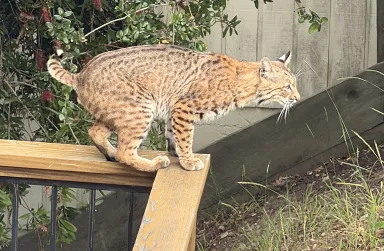
The Secret Nocturnal Shift:
How Wild Cats Change Their Schedules to Avoid Us
- Author: Regan Crisp
- Publication Date: July 20, 2026
- Related Projects: Bay Area Puma Project, Bay Area Bobcat Project, Diablo PumaLink Project, Living with Lions
- Focus Species: Lynx rufus (Bobcat) , Puma concolor (Mountain Lion)
The San Francisco Bay Area is famous for its sweeping landscapes and diverse wildlife. But at the urban edge, where wilderness meets our backyards, human-animal encounters are inevitable. For many residents, catching a glimpse of a wild cat, mountain lion or bobcat is one of the most unsettling possibilities. These elusive predators thrive in everything from the dense foothills and chaparral to deep redwood forests. Yet despite their preference for staying hidden, their reputation as fearsome hunters usually precedes them.
What many people overlook is that these ecosystems depend on wild cats to survive. They are the balancing force. Without apex predators keeping other wildlife populations in check, plant life suffers, biodiversity declines, and the entire ecosystem spirals out of balance (1). Simply put: if we protect bobcats and mountain lions, they protect our shared environment.
Finding a way for humans and wild cats to peacefully coexist is the driving force behind the Felidae Conservation Fund’s community outreach work. Our ongoing research provides communities with practical tools to mitigate conflicts while giving us the insights needed to protect these animals and their habitats.
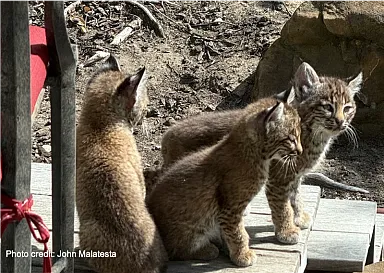
A recent Felidae study (2) threw a spotlight on exactly how human presence alters the daily lives of pumas and bobcats. Through the Bay Area Puma Project (BAPP), the Felidae team regularly monitors these species using an extensive network of remote trail cameras across the state. The study compared the daily activity patterns of pumas, bobcats, and mule deer across two distinct regions: San Mateo County and Orange County.
The goal was to look at human disturbances, specifically noise and artificial light pollution. The researchers discovered a direct link between the intensity of nighttime lighting and the cats’ schedules. Naturally, pumas and bobcats are crepuscular, meaning they are most active between dusk and dawn. However, closer to urban areas brightened by light pollution, these wild cats are dramatically shifting their schedules to become strictly nocturnal. While they seem less bothered by our noise, when human presence is highly visible, these already elusive creatures do everything they can to give us space.
These findings match previous ecological research indicating that wild cats want to avoid us just as much as we want to avoid them. The dark offers them a shield of safety, allowing them to hunt and travel with minimal interference. As the global human footprint expands and cities grow, understanding and respecting this behavioral shift becomes vital to their survival. The night is increasingly becoming the only true refuge wildlife has left from our daily routines (3,4)
The shift toward the night has massive implications for how we design our communities and protect ourselves. Reserving large, connected, low-illumination open spaces can meaningfully buffer wildlife from our sensory pressures (2).
We can also use our knowledge of their nighttime shifts to prevent chance encounters. To stay safe, humans should avoid hiking or running at dawn, dusk, and after dark. It also helps to keep perspective: you are statistically 150 times more likely to be killed by a deer on the road, and even bees account for more annual deaths than wild cats. For those living near the urban edge or in wooded communities, simple steps like installing motion-activated home lighting and bringing pets inside before sunset use the cats’ natural patterns to keep everyone safe.
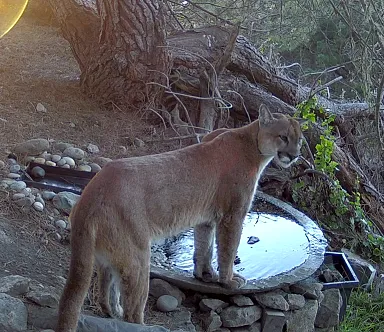
Ultimately, we can use lighting, or the intentional lack of it, to preserve natural conditions for these species to hunt and thrive. Simple policies, like asking park visitors to limit trail use to daytime hours, create predictable, dark nighttime conditions that give wildlife the room they need, dramatically reducing the chances of conflict.
Mountain lions are not inherently dangerous. We are simply building and living in their historic territories. Doing so thoughtfully changes everything. By coordinating efforts to reduce light pollution and aligning park recreation with natural wildlife patterns, we can use smart, cost-effective strategies to protect biodiversity (2).
They may be incredibly skilled, intimidating hunters of their prey, but to us, they are just neighbors. Like any good neighbor, we merely need to do our part to keep the peace.
References
- LaBarge, L.R., et al. 2022. Pumas Puma concolor as ecological brokers: a review of their biotic relationships. Mammal Review, 52: 360-376.
- Granados, A., et al. 2026. Illuminated landscapes: urbanization’s influence on predator and prey behavior. Urban Ecosystems, 29: 82.
- Burton, A.C., et al. 2024. Mammal responses to global changes in human activity vary by trophic group and landscape. Nature Ecology & Evolution, 8: 924-935.
- Gaynor, K.M., et al. 2018. The influence of human disturbance on wildlife nocturnality. Science, 360: 1232-1235.
Do You Have 2-4 Hours A Month To Preserve Your Local Ecosystem?
Our volunteers are the driving force behind making true change in ecosystem health and wild cat conservation. Some like to volunteer in the field, others help us maintain our online presence, and some work with events. With just a few hours a month, you can make a difference, too.
Make A Difference Right Now
As a 501(c)3 nonprofit, our work is only possible because of generous donors like you.
More than 93% of your donation will go directly to our groundbreaking research, outreach, and education programs.
This is where true change starts. If you’d like to be a part of it, make a donation to Felidae Conservation Fund today:
Or,