
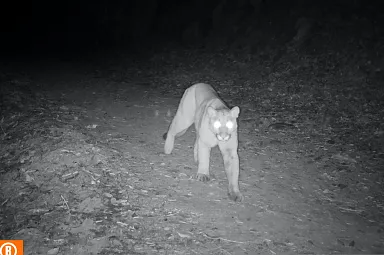
Rewilding in Real Time:
Evidence for Cougar Recolonization in the Eastern United States
- Author: Alys Granados & Sean Verdi
- Publication Date: November 25, 2025
- Related Project: Bay Area Puma Project
- Focus Species: Puma concolor (Mountain Lion)
Historically, pumas were found from the Appalachians to New England, but by the late 1800s, they disappeared from the eastern US after being hunted to extinction. In 2011, the eastern cougar (Puma concolor couguar) was officially declared extinct by US Fish and Wildlife (1), and today, puma distribution is limited to the western states. In recent years, however, instances of dispersing pumas appearing in the Midwest suggest the potential for their return is greater than previously thought. This has led ecologists and wildlife managers to consider the potential ecological impacts of puma recolonization on the East Coast.
As a keystone species, puma presence affects ecosystem health as well as the presence and behaviour of co-occurring species. Pumas maintain direct and indirect relationships with nearly 500 other species (2). As predators, they regulate prey populations. Throughout their range, their preferred prey tends to be ungulates (i.e., hoofed animals), and by preying on animals like deer, they prevent overgrazing, helping to promote vegetation growth and survival. When pumas make a deer kill, they will stash the carcass, returning over 2-3 days, during which other species like coyotes or bobcats, and even birds of prey, for example, will scavenge on it.
The absence of apex predators like pumas can disrupt ecosystem balance, altering prey population abundances as well as plant biodiversity and survival. Declines in apex predators can leave deer populations unchecked. The reintroduction of pumas to the East Coast could help address the increasingly degraded landscape caused by unsustainable white-tailed deer numbers (3). Here, white-tailed deer densities are among the highest in the country, with high deer numbers resulting in overgrazing, overbrowsing, and the disruption of ecological services. In the Great Lakes region, for example, white tailed deer have negatively affected plant biodiversity in forests by hindering the regeneration of several important conifer species (4). Even birds may show declines in response to high deer densities (5). Importantly, high deer densities could contribute to zoonotic spillover. Deer carry tick-borne diseases like Lyme disease, which can be transmitted to humans, especially in areas where deer (and tick) abundance are high, such as in suburban areas (6). Besides Lyme disease, pumas can help control the spread of chronic wasting disease (CWD), a neurological disease spread directly and indirectly that affects deer, elk, and moose. CWD is a major challenge for wildlife managers, still working to understand the conditions under which it continues to spread geographically across the US. Pumas may selectively prey on diseased deer (7), thereby preventing the spread of CWD, illustrating the importance of native predators in mitigating zoonotic spillover. Without native predators, however, white-tailed deer numbers remain high.
Already, pumas have dispersed east, particularly to the Midwest (8,9), with breeding expected at some point in the future (10). As such, researchers expect pumas will re-establish their former range. Recent work suggests this may be possible. Scientists identified large, connected habitat patches with abundant prey in the Appalachians, New England, and the Ozarks, which could potentially support puma populations (11). Other researchers recently modeled the potential for puma range expansion in North America, highlighting the potential for breeding populations of pumas in Minnesota, Oklahoma, eastern Nebraska, Iowa, and Kansas, as well as Manitoba and Saskatchewan (12).
Dispersing male pumas have reached parts of the Midwest, indicating potential for range expansion, though widespread recolonization may depend on improved connectivity between remaining wildlife habitats (12). One young male was also found to have dispersed from the Black Hills in South Dakota all the way to Connecticut, covering roughly 1800 miles on the way (13). Such dispersal events suggest these movements are possible for other pumas and successful establishment could be more likely in areas with low human population density, low livestock presence, and greater proximity to highways (11).
Public support for puma recolonization also seems to be encouraging. A survey of almost 3000 people across multiple states indicated that support outweighed the extent of opposition in each state where people were surveyed (14). Also, there could be significant economic benefits to their return. A 2017 study estimated that the return of pumas to the eastern US could reduce deer–vehicle collisions by roughly 22% over 30 years, preventing over 21,000 human injuries, 155 deaths, and $2 billion dollars in damages (15).
Still, not everyone is in favor of a potential puma’s return. Concerns remain about the lack of suitable habitat available in parts of their former range (16), which could undermine the persistence of pumas in this landscape, particularly given the prevalence of barriers like major highways that fragment remaining wilderness habitat. In Vermont, for example, it’s estimated there may only 12,000 sq km of habitat left because the remaining habitat is fragmented by I-680. This area is said to be too small to sustain a genetically diverse population. This underscores some of the concerns with how successful pumas could realistically be in the long term in the eastern US. Further, there are concerns about potential conflicts with pets and livestock and the upfront costs associated with reintroducing pumas to their former range, should active rewilding be undertaken.
While the rate at which pumas may return will likely be gradual, their return of pumas to eastern North America could be an effective ecological restoration opportunity for degraded landscapes. The presence of available habitat along with prey indicates there is an opportunity for recolonization and their return could greatly benefit the ecosystem.
References
- US Fish and Wildlife. No date. Eastern Cougar. https://www.fws.gov/species/eastern-cougar-puma-concolor-couguar
- LaBarge, L.R., Evans, M.J., Miller, J.R., Cannataro, G., Hunt, C. and Elbroch, L.M., 2022. Pumas Puma concolor as ecological brokers: a review of their biotic relationships. Mammal Review, 52(3), 360-376.
- Audubon Magazine. 2024. Surging Deer Populations Are a Crisis for Eastern Forests. https://www.audubon.org/magazine/surging-deer-populations-are-crisis-eastern-forests
- Rooney, T.P. and Waller, D.M., 2003. Direct and indirect effects of white-tailed deer in forest ecosystems. Forest ecology and management, 181(1-2), 165-176.
- deCalesta, D.S., 1994. Effect of white-tailed deer on songbirds within managed forests in Pennsylvania. The Journal of Wildlife Management, 711-718.
- Kilpatrick, H.J., Labonte, A.M. and Stafford III, K.C., 2014. The relationship between deer density, tick abundance, and human cases of Lyme disease in a residential community. Journal of Medical Entomology, 51(4), 777-784.
- Krumm, C.E., Conner, M.M., Hobbs, N.T., Hunter, D.O. and Miller, M.W., 2010. Mountain lions prey selectively on prion-infected mule deer. Biology Letters, 6(2), 209-211.
- Larue, M.A., Nielsen, C.K. and Pease, B.S., 2019. Increases in Midwestern cougars despite harvest in a source population. The Journal of Wildlife Management, 83(6), 1306-1313.
- Smith, J.B., Nielsen, C.K. and Hellgren, E.C., 2016. Suitable habitat for recolonizing large carnivores in the midwestern USA. Oryx, 50(3), pp.555-564.
- LaRue, M.A., Nielsen, C.K., Dowling, M., Miller, K., Wilson, B., Shaw, H. and Anderson Jr, C.R., 2012. Cougars are recolonizing the midwest: analysis of cougar confirmations during 1990–2008. The Journal of Wildlife Management, 76(7), 1364-1369.
- Yovovich, V., Robinson, N., Robinson, H., Manfredo, M.J., Perry, S., Bruskotter, J.T., Vucetich, J.A., Solórzano, L.A., Roe, L.A., Lesure, A. and Robertson, J., 2023. Determining puma habitat suitability in the Eastern USA. Biodiversity and Conservation, 32(3), 921-941.
- Glass, T.W., Beausoleil, R.A., Elbroch, L.M., Kertson, B.N., Maletzke, B.T., Martins, Q., Matchett, M.R., Vickers, T.W., Wilmers, C.C., Wittmer, H.U. and Robinson, H., 2024. Limited cougar recolonization of eastern North America predicted by an individual-based model. Biological Conservation, 298, 110756.
- Hawley JE, Rego PW, Wydeven AP, Schwartz MK, Viner TC, Kays R, Pilgrim KL, Jenks JA (2016) Long-distance dispersal of a subadult male cougar from South Dakota to Connecticut documented with DNA evidence. J Mammal 97(5):1435–1440.
- Elbroch, L.M., Murphy, J.J., Carlson, S.C., Vucetich, J.A., Berl, R.E., Galiardi, L., Perry, S., Butler, T., Carter, N., Hinton, J.W. and Moehrenschlager, A., 2025. Public support for puma reintroduction in the eastern United States. Conservation Science and Practice, 7(8), e70105.
- Gilbert, S.L., Sivy, K.J., Pozzanghera, C.B., DuBour, A., Overduijn, K., Smith, M.M., Zhou, J., Little, J.M. and Prugh, L.R., 2017. Socioeconomic benefits of large carnivore recolonization through reduced wildlife‐vehicle collisions. Conservation Letters, 10(4), 431-439.
- Compas Vermont. 2025. The Catamount Conundrum: The Pros and Cons of Reintroducing a Native Predator to Vermont. https://www.compassvermont.com/p/the-catamount-conundrum-the-pros
Do You Have 2-4 Hours A Month To Preserve Your Local Ecosystem?
Our volunteers are the driving force behind making true change in ecosystem health and wild cat conservation. Some like to volunteer in the field, others help us maintain our online presence, and some work with events. With just a few hours a month, you can make a difference, too.
Make A Difference Right Now
As a 501(c)3 nonprofit, our work is only possible because of generous donors like you.
More than 93% of your donation will go directly to our groundbreaking research, outreach, and education programs.
This is where true change starts. If you’d like to be a part of it, make a donation to Felidae Conservation Fund today:
Or,