
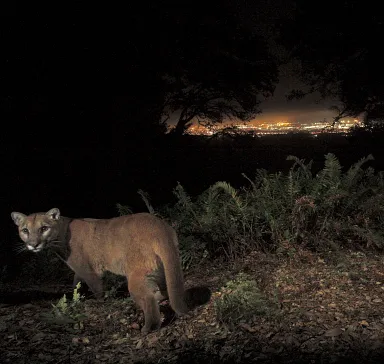
Exploring the Influence of Artificial Light Pollution on Carnivore Behavior
- Author: Alys Granados
- Publication Date: April 07, 2026
- Related Projects: Bay Area Puma Project, Bay Area Bobcat Project
- Focus Species: Lynx rufus (Bobcat) , Puma concolor (Mountain Lion)
Human-driven habitat loss and fragmentation continue to threaten wildlife globally, with medium and large-bodied mammals at particularly high risk of extinction due to their large space requirements and slow reproductive rates. While many studies have explored how animals shift their spatial behavior to avoid human-dominated areas (e.g., urban development, roads), a growing body of research is examining how human activity alters when animals are active.
In 2018, Gaynor et al (1) showed that wildlife often becomes more nocturnal in areas with higher human disturbance as a strategy to avoid people. More recently, a global analysis of over 100 camera trap projects found that carnivores, in particular, exhibit the greatest increases in nocturnality in high human-use areas (2). However, as human footprint continues to expand, key questions remain about which aspects of urbanization are driving these shifts.
At the urban-wildland interface, this question is particularly important. Shifts in activity across the 24-hour cycle can directly influence the likelihood of human-wildlife conflict. For carnivores at the urban edge, this may include encounters with people in neighborhoods or on trails, as well as depredation on pets.
Sensory pollutants, such as light and noise, are defining features of urban environments and are increasingly recognized for their role in shaping wildlife behavior (3,4). Artificial light pollution is now so widespread that even protected areas experience elevated nighttime illumination compared to historical conditions (5). This raises an important question: how does artificial light alter wildlife behavior at the urban edge, particularly daily activity patterns?
In Felidae’s recent study published in Urban Ecosystems, we investigated how urban development and human activity influence nighttime activity in pumas, bobcats, and mule deer. We used data from our long-term camera trap network in the San Francisco Bay Area and Orange County, along with data provided by the Irvine Ranch Conservancy.
Our dataset included 61 camera traps deployed over three years, allowing us to examine the effects of artificial light pollution, human activity, proximity to noise, and detections of co-occurring species. Study sites spanned open spaces in two of California’s most urbanized regions, San Mateo County and Orange County. Both regions contain protected area networks under intense development pressure and support similar wildlife communities and climate. However, Orange County has one of the highest human population densities in the state, providing a useful contrast to isolate how increasing human footprint, and particularly light pollution, shapes wildlife behavior.
We found that light pollution exerted a strong influence on carnivores. Both pumas and bobcats showed reduced nighttime activity in brighter areas, and pumas were less likely to be detected near areas with higher human presence. Puma activity was also positively associated with mule deer, their primary prey in California.
In contrast, mule deer responded differently as they increased nighttime activity in brighter areas while avoiding locations closer to noise pollution.
Implications for the Real World
Our findings identify artificial light pollution as a key, and often overlooked, driver of wildlife behavior. As urban development continues to expand, mitigating its impacts on wildlife will require more intentional management of light. This includes reducing skyglow, limiting light spillover into adjacent open spaces, and adopting Dark Sky-aligned policies (6).
Globally, more than 230 sites have been certified under Dark Sky standards, including 165 in the United States (6,7). In the Bay Area, municipalities such as Palo Alto, have begun implementing similar measures. However, in highly urbanized regions with vulnerable wildlife populations, such as Orange County, no certified sites currently exist (6). This represents a significant gap and opportunity for conservation action.
These behavioral shifts also carry implications for public safety. As human activity increasingly extends into nighttime hours, overlap with large carnivores may increase the risk of conflict (8 Aditya and Ganesh 2022). Reducing that risk will require not only changes in land-use planning, but also shifts in human behavior, such as encouraging daytime recreation in wildlife areas and enforcing existing park guidelines.
Creating darker, more predictable nighttime conditions can provide critical temporal refuges for wildlife, supporting healthier ecosystems while reducing the likelihood of conflict at the urban edge.
You can read our full paper here:
References
(1) Gaynor, K.M., Hojnowski, C.E., Carter, N.H. and Brashares, J.S., 2018. The influence of human disturbance on wildlife nocturnality. Science, 360: 1232-1235.
(2) Burton, A.C., Beirne, C., Gaynor, K.M., Sun, C., Granados, A., et al. 2024. Mammal responses to global changes in human activity vary by trophic group and landscape. Nature ecology & evolution, 8: 924-935.
(3) Beier, P., Effects of artificial night lighting on terrestrial mammals. Ecological consequences of artificial night lighting 19–42 (2006) [online]
(4) Sunde, P., Kjeldgaard, S.A., Mortensen, R.M. and Olsen, K., 2024. Human avoidance, selection for darkness and prey activity explain wolf diel activity in a highly cultivated landscape. Wildlife Biology, 2024: e01251.
(5) Kyba, C.C., Kuester, T., Sánchez de Miguel, A., Baugh, K., Jechow, A., Hölker, F., Bennie, J., Elvidge, C.D., Gaston, K.J. and Guanter, L., 2017. Artificially lit surface of Earth at night increasing in radiance and extent. Science advances, 3: e1701528.
(6) Dark Sky International. 2025. https://darksky.org/
(7) Barentine, J.C., 2022. Night sky brightness measurement, quality assessment and monitoring. Nature Astronomy, 6(10), pp.1120-1132.
(8) Aditya, V. and Ganesh, T., 2022. Insights into human‐wildlife coexistence through temporal activity pattern overlaps in a neglected tropical forest in India. Biotropica, 54: 1390-1399.
Do You Have 2-4 Hours A Month To Preserve Your Local Ecosystem?
Our volunteers are the driving force behind making true change in ecosystem health and wild cat conservation. Some like to volunteer in the field, others help us maintain our online presence, and some work with events. With just a few hours a month, you can make a difference, too.
Make A Difference Right Now
As a 501(c)3 nonprofit, our work is only possible because of generous donors like you.
More than 93% of your donation will go directly to our groundbreaking research, outreach, and education programs.
This is where true change starts. If you’d like to be a part of it, make a donation to Felidae Conservation Fund today:
Or,