
Avian Flu at the Urban Edge:
Risks to Wild Cats and Human Health
- Author: Nikita Sabnis
- Publication Date: April 06, 2026
- Related Projects: Bay Area Puma Project, Bay Area Bobcat Project, Diablo PumaLink Project, Bhutan Wild Cat Health Project, Wild Cat Health Project
- Focus Species: Lynx rufus (Bobcat) , Puma concolor (Mountain Lion)
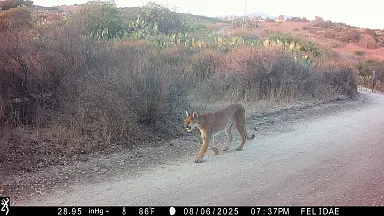
Avian flu (also known as bird flu or H5N1) is back in the headlines, and increasingly close to home. Since February 2026, confirmed cases of the H5N1 strain have led to deaths of elephant seals at Año Nuevo State Park and common murres at Point Reyes National Seashore, where Felidae conducts fieldwork for the Bay Area Puma project. These events underscore how little we still understand about how this strain affects wildlife at the urban-wildland interface, particularly native predators such as pumas and bobcats. Documented cases of avian flu in wild felids further highlight the urgency of understanding how this virus may impact already vulnerable populations.
Highly pathogenic avian influenza (HPAI H5N1) first emerged in 1996. While initially confined to birds, it has evolved significantly over the past three decades. By 2004, the first fatal cases were documented in tigers and leopards [1,2]. Since then, evidence has continued to grow: felids, including both domestic cats and wild species such as pumas, are highly susceptible to HPAI H5N1 and may play a role in cross-species transmission.
Wild felids are most often infected through scavenging or predation, consuming infected bird carcasses, hunting sick waterfowl, or ingesting contaminated food sources. Early outbreaks in Thailand in 2004 [3] marked the first recorded deaths in tigers and leopards in captive settings, with additional mortality events documented since [3,4]. Transmission among felids can occur through direct contact [2], particularly in captive environments where animals are in close proximity. In free-ranging wild populations, direct transmission appears more limited; however, spillover dynamics remain poorly understood. Importantly, outbreaks in felids have been associated with human infections[4-6], underscoring the need to identify where and how spillover risks are elevated.
What has been the impact of avian flu on wild cats to date? A 2025 global review offers sobering insight: between 2004 and 2024, at least 302 deaths from avian flu were documented among felids across 18 countries and 12 species, including tigers, lions, leopard cats, caracals, and lynx [7,8].
Closer to home, several cases have been reported in native wild cats in the United States. The first confirmed HPAI infection in a puma was documented in Nebraska in 2023 [9]. By late 2024, an outbreak at a Washington sanctuary resulted in the deaths of 20 wild cats, including four pumas and two bobcats. To date, California and Washington have recorded at least 12 fatal cases in wild pumas [10].
The health consequences for infected felids are severe. Clinical signs include pneumonia, fever, encephalitis (brain inflammation), and multi-organ failure [9, 11]. Behavioral changes have also been observed: infected pumas in California and Washington died within 4–7 days of symptom onset [12], often showing altered movement patterns, reduced activity, and prolonged resting periods prior to death [12].
Despite these alarming signals, major knowledge gaps remain. We do not yet understand how avian flu may affect wild felid populations over the long term, particularly in fragmented landscapes where populations are already under pressure. Disease may act as a compounding threat, interacting with habitat loss, human encroachment, and reduced genetic connectivity. The risk of spillover between wildlife, domestic animals, and humans is especially heightened in urban and peri-urban environments, where these interfaces are most pronounced.
Our understanding of how human-driven environmental change influences wildlife health, and, in turn, zoonotic risk, remains limited. To address this, Felidae launched the Wild Cat Health Project in 2024, a multi-year initiative to monitor puma and bobcat health at the urban-wildland interface. Using non-invasive methods, including detection dogs trained to locate wild felid scat, we are collecting critical data across the San Francisco Bay Area and Southern CA. The work is designed to reveal how urbanization shapes disease exposure, immune health, and pathogen transmission in wild carnivores.
At a time when avian influenza is expanding its reach across species and landscapes, understanding its impacts at the top of the food chain is no longer optional; it is essential. Apex predators like pumas and bobcats are not only indicators of ecosystem health, but also sentinels for emerging public health risks. Investing in long-term, field-based surveillance at the urban edge is one of the most effective ways to detect early warning signals, reduce spillover risk, and inform proactive responses that protect both wildlife and people.
References
[1] World Health Organization. 2024. Avian influenza A (H5N1)—update 28: reports of infection in domestic cats (Thailand), situation (human) in Thailand, situation (poultry) in Japan and China.
[2] Kuiken T, Rimmelzwaan G, van Amerongen G, et l. 2004. Avian H5N1 influenza in cats. Science. 306: 241.
[3] Keawcharoen J, Oraveerakul K, Kuiken T, F et al. 2004 Avian influenza H5N1 in tigers and leopards. Emerging Infectious Diseases. 10:2189.
[4] Thanawongnuwech R, Amonsin A, Tantilertcharoen R, et al. 2005. Probable tiger-to-tiger transmission of avian influenza H5N1. Emerging Infectious Diseases 11: 699–701.
[5] Lee CT, Slavinski S, Schiff C, et al. 2017. Outbreak of influenza A(H7N2) among cats in an animal shelter with cat-to-human transmission—New York City, 2016. Clinical Infectious Diseases. 65:1927–9.
[6] Poirot E, Levine MZ, Russell K, et al. 2019. Detection of avian influenza A(H7N2) virus infection among animal shelter workers using a novel serological approach— New York City, 2016–2017. Journal of Infectious Diseases 219:1688–96.
[7] Coleman KK and Bemis IG. 2025. Avian influenza virus infections in felines: a systematic review of two decades of literature. In Open Forum Infectious Diseases. 12(5). US: Oxford University Press.
[8] Gwon SH, Park SI, Jeong H, et al. 2026. Fatal H5N1 Highly Pathogenic Avian Influenza with Retrograde Neuroinvasion in a Free-Ranging Leopard Cat (Prionailurus bengalensis) During a Wild Bird Outbreak in South Korea. Animals. 16(2):200.
[9] Animal and Plant Health Inspection Service. 2026. Detections of highly pathogenic avian influenza in mammals. https://www.aphis.usda.gov/livestock-poultry-disease/avian/avian-influenza/hpai-detections/mammals?page=1
[10] CDFW 2023. Avian influenza detected in deceased mountain lions. https://wildlife.ca.gov/News/Archive/avian-influenza-detected-in-deceased-mountain-lions
[11] Burrough E, Magstadt D, Petersen B, et al. 2024. Highly pathogenic avian influenza A(H5N1) clade 2.3.4.4b virus infection in domestic dairy cattle and cats, United States. Emerging Infectious Diseases 30: 1335–1343
[12] Nájera F, Uiterwaal S, Garcelon DK, et al. 2025. Impacts of infectious diseases on movement metrics in a large carnivore: Highly pathogenic avian influenza, leptospirosis, and pumas. iScience. 28(11).
Do You Have 2-4 Hours A Month To Preserve Your Local Ecosystem?
Our volunteers are the driving force behind making true change in ecosystem health and wild cat conservation. Some like to volunteer in the field, others help us maintain our online presence, and some work with events. With just a few hours a month, you can make a difference, too.
Make A Difference Right Now
As a 501(c)3 nonprofit, our work is only possible because of generous donors like you.
More than 93% of your donation will go directly to our groundbreaking research, outreach, and education programs.
This is where true change starts. If you’d like to be a part of it, make a donation to Felidae Conservation Fund today:
Or,