Eyes in the Wild:
The AI Revolution in Conservation Science
Wildlife researchers today can collect ecological data at scales that were unimaginable a decade ago. Advances in technology, especially remote cameras, acoustic sensors, and cloud-based systems, now allow scientists to monitor wildlife continuously across vast landscapes, without ever disturbing the animals they study. Camera traps, in particular, have become one of the most powerful tools in modern ecology: low cost, non-invasive, and capable of recording multiple species around the clock.
But with this unprecedented view into the natural world comes an equally enormous challenge. These tools generate massive datasets, often millions of images and audio files per project, and sorting through them can be overwhelming. Extracting insight from this flood of data requires new solutions. This is where Artificial Intelligence (AI) has quickly become indispensable.
A New Era For Ecology
AI, first formally defined in 1956 [11], has quietly woven itself into nearly every part of modern life, from navigation apps to text prediction to the photos on your phone. Over the past few years, ecological research has embraced these advancements at a remarkable speed. Automated image and sound recognition tools are now routine in conservation science, taking over tasks that once required months or years of manual effort.
Popular citizen science platforms such as iNaturalist and Merlin have used AI as early as 2017 to help users identify plants, animals, and fungi [4,5]. These same techniques are transforming professional wildlife monitoring programs as well.
How Felidae Uses AI to Study Wild Cats
At Felidae Conservation Fund (Felidae), AI has become central to turning millions of camera trap images into actionable ecological information. With the support of more than 300 trained volunteers, Felidae has annotated over two million images since 2021, including more than 40,000 photos of pumas and bobcats across California.
This work is powered by WildePod, Felidae’s cloud-based platform built explicitly to handle large-scale wildlife data. WildePod integrates several free, open-source AI models that dramatically speed up the classification process.
MegaDetector: The First Filter
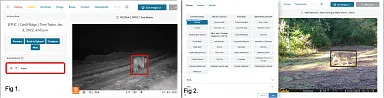
The first model in the workflow is MegaDetector, developed by Sara Beery and Dan Morris, and Google AI for Nature. MegaDetector identifies animals, people, and vehicles in camera trap images and automatically removes empty frames, the “false triggers” caused by wind, shadows, or moving vegetation (Fig.1) [1,12,14]. These false triggers can account for thousands of unnecessary images in a single dataset.
By filtering out all the noise, MegaDetector allows Felidae’s volunteers to focus on the images that actually matter.
SpeciesNet: Zeroing in On Species
Felidae is also implementing SpeciesNet, developed last year by Tomar Gadot and colleagues. SpeciesNet builds on MegaDetector’s output and suggests likely species IDs (Fig. 2), improving classification speed and accuracy. The newest version of SpeciesNet is even more powerful, adding the capability to automatically annotate images that meet a confidence interval while being processed [15]. Paired together, the two models eliminate blank images, pre-process images, and help volunteers quickly annotate photos of interest [3], making Felidae’s long-term felid monitoring more efficient and sustainable.
In parts of Africa and Asia, edge AI systems (i.e. AI technology integrated locally) alert rangers when elephants approach farms, helping reduce human-wildlife conflict [6]. In India, AI-enabled camera traps can even deploy non-lethal, species-specific deterrents when certain animals approach crops [7].
Before these systems existed, families often stayed awake all night guarding their fields. Now, AI allows them to sleep while still keeping wildlife and livelihoods safe.
Felidae’s Next Step: Real-Time Health Monitoring
Felidae is now integrating similar edge-AI capabilities into our population and health monitoring programs. Fecal and hair samples provide critical insights into parasite loads, toxins, diet, stress, and individual identity through DNA. Hair snare stations use scent or visual lures to collect hair samples non-invasively.
When paired with camera traps, researchers can confirm which species, and often which individual, visited a snare station. With edge AI, the system can send real-time notifications whenever a target species interacts with a snare station, enabling fast retrieval of samples before they degrade. These advances will significantly increase the quality and reliability of genetic data for pumas, bobcats, and other wild cats.
AI That Knows Who’s Who
AI has now advanced to the point where it can identify individual animals. Recently, USGS and the University of Virginia developed software capable of recognizing individual trout from photographs [8], no invasive tags required. Anglers may soon be able to upload a photo of a fish and instantly learn whether it has been caught before and where it has traveled.
The Giraffe Conservation Foundation has created a similar tool for giraffes, using crowd-sourced photos to build individual ID catalogs [9]. These technologies open the door to fully non-invasive population monitoring, fueled in part by citizen scientists around the world.
Looking Ahead: Predicting the Future
While current AI tools help conserve wildlife by processing data faster, the most transformative possibilities lie ahead. Leading experts in AI and conservation suggest that the future will focus on predictive modeling, systems that can forecast population trends, habitat shifts, disease outbreaks, or conflict hotspots before they occur [10].
Such tools could allow conservation scientists and land managers to act sooner, make decisions more confidently, and handle ecological challenges that are growing more complex by the year.
References
[1] Microsoft. (2020). AI for Earth camera trap image processing API (Version 6.1) [Computer software].
[2] WILDLABS. (2025, March 3). We are releasing SpeciesNet.
[3] Gadot, T., et al. (2024). To crop or not to crop: Comparing whole-image and cropped classification on a large dataset of camera trap images. IET Computer Vision, 18(8), 1193–1208.
[4] iNaturalist. No date. Computer vision demo.
[5] Hoffman, B., & Van Horn, G. (2021, June 22). Behind the scenes of Sound ID in Merlin. Macaulay Library.
[6] One Earth. (2021, October 25). WildEyes AI: Helping to save wild elephants and prevent human-elephant conflict.
[7] Abed, N., Murugan, R., Deldari, A., Sankarannair, S., & Ramesh, M. V. (2025). IoT and AI-driven solutions for human-wildlife conflict: Advancing sustainable agriculture and biodiversity conservation. Smart Agricultural Technology, 10, Article 100829.
[8] Candelier, E. (2023, September 25). Fish-ial recognition software aims to protect trout. School of Data Science, University of Virginia.
[9] Giraffe Conservation Foundation. No date. GiraffeSpotter: Wildbook for giraffe.
[10] Reynolds, S. A. et al. (2025). The potential for AI to revolutionize conservation: A horizon scan. Trends in Ecology & Evolution, 40(2), 191–207.
[11] Dartmouth College. No date. Artificial intelligence (AI) coined at Dartmouth. Dartmouth.
[12] Kaltenbach, T. L., Mosley, J. C., McNew, L. B., & Beaver, J. T. (2025). Can edge AI mitigate environmental effects on camera trap performance? Wildlife Society Bulletin, 49, e1598.
[13] Stetz, J. B., Seitz, T., & Sawaya, M. A. (2015). Effects of exposure on genotyping success rates of hair samples from brown and American black bears. Journal of Fish and Wildlife Management, 6(1), 191–198.
[14] Beery, S., Morris, D., Yang, S., 2019a. Efficient pipeline for camera trap image review. ArXiv:1907.06772
[15] WILDLABS. (2025, June 22). Try new SpeciesNet + Animal Detect combination online.
Do You Have 2-4 Hours A Month To Preserve Your Local Ecosystem?
Our volunteers are the driving force behind making true change in ecosystem health and wild cat conservation. Some like to volunteer in the field, others help us maintain our online presence, and some work with events. With just a few hours a month, you can make a difference, too.
Make A Difference Right Now
As a 501(c)3 nonprofit, our work is only possible because of generous donors like you.
More than 93% of your donation will go directly to our groundbreaking research, outreach, and education programs.
This is where true change starts. If you’d like to be a part of it, make a donation to Felidae Conservation Fund today:
Or,