
Bhutan’s Secret Cats:
New Jungle Cat Discovery at Nearly 4,000 Meters
Bhutan is home to an astonishing nine species of wild cats, a remarkable number for a country roughly the size of Switzerland. Yet most people only hear about the larger, well-known cats like snow leopards in the high Himalayas or Bengal tigers in subtropical forests. These charismatic species often make conservation headlines, leaving their smaller cousins largely overlooked.
This is true not just in Bhutan, but globally. Small wild cats, such as the marbled cat, leopard cat, Asiatic golden cat, and jungle cat, remain among the least studied carnivores on Earth (1). Because they are solitary, elusive, and sometimes mistaken for domestic cats, researchers have far less information about their behavior, habitat needs, and population trends.
Meet the Jungle Cat
At first glance, jungle cats could pass for a large, lanky house cat. Their coats are mostly uniform in color, shades of gray, reddish-brown, or tan, and adults weigh between 2 and 16 kilograms. Despite a wide distribution spanning the Middle East through Central and Southeast Asia, jungle cats remain poorly understood. Basic, fine-scale information about their habitat preferences is lacking across much of their range.
Although the IUCN Red List currently classifies the species as Least Concern, that status masks a troubling reality: jungle cat populations are declining rapidly (2). The expansion of agriculture has destroyed and fragmented their natural habitat, especially wetlands. They are also frequently caught in snares, trapped intentionally or unintentionally, and sometimes poisoned (2).
Despite these threats, no population estimate exists anywhere within their range, including Bhutan.
Our Work in Bhutan
Earlier this year, Felidae launched the Bhutan Wild Cat Health Project, a multi-year initiative designed to bring long-needed attention to the country’s lesser-known felids, jungle cats included. The project is collecting data to understand how wild cats use Bhutan’s landscapes and how their health and behavior are shaped by human activity and the presence of free-ranging domestic dogs. Dogs can harass wildlife, compete with carnivores, or spread diseases such as canine distemper and rabies, posing significant risks to wild populations (3).
To tackle these questions, Felidae and Bhutanese researchers are deploying one of the country’s most extensive camera-trap networks and conducting wide-ranging scat surveys across major protected areas. Even though the cameras have only been active since the summer, they are already producing valuable new insights, especially for species that are notoriously difficult to document.
A First for Wangchuck Centennial National Park
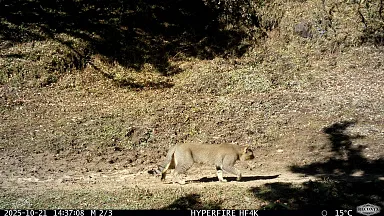
In August, a camera trap in Wangchuck Centennial National Park captured an unmistakable image, a jungle cat. This is the first-ever record of the species in the park. With this new detection, the park has now confirmed all nine of Bhutan’s wild cat species, an extraordinary distinction shared by very few protected areas worldwide.
The sighting is notable for another reason: altitude. The camera was set at 3,887 meters above sea level, near the species’ known upper limit. Their previous documented maximum elevation was 4,178 meters (2). This suggests jungle cats may be more adaptable than previously understood.
Why This Discovery Matters
Bhutan is internationally recognized as a biodiversity hotspot, where ecosystems rely on a delicate balance of species interactions (4). Carnivores are especially important: Big cats like tigers regulate populations of deer and wild pigs, preventing overgrazing; Smaller cats, including the jungle cat, help control rodents, reptiles, and other small prey, providing a natural pest control.
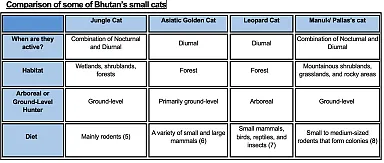
Even among small cats, differences in hunting style, habitat preference, and behavior shape how each species influences the broader ecosystem.
A new jungle cat record at high altitude expands what scientists know about this species’ adaptability, where it can survive, what it might be eating, and how it coexists with other carnivores in a landscape increasingly shaped by people. For a species with so little research behind it, every new data point helps build the foundation needed to support its long-term conservation.
Learn More
To read more about the Bhutan Wild Cat Health Project, visit: https://felidaefund.org/projects/research/bhutan-wild-cat-health-project
References
(1) Chiaverini, L, et al. 2025. Identifying gaps in the conservation of small wild cats of Southeast Asia. Biodiversity and Conservation, 34(4), 1471–1495.
(2) Gray, T.N.E. et al. 2021. Felis chaus (amended version of 2016 assessment). The IUCN Red List of Threatened Species 2021: e.T8540A200639312. https://dx.doi.org/10.2305/IUCN.UK.2021-2.RLTS.T8540A200639312.en. Accessed on 11 December 2025.
(3) Costanzi, L et al. 2021. Beware of dogs! Domestic animals as a threat to wildlife conservation in Alpine protected areas. European journal of wildlife research, 67(4), 70.
(4) Nepal, T.K. 2022. An Overview of Biodiversity in Bhutan. Asian Journal of Research in Agriculture and Forestry, 8(1), 7–19.
(5) IUCN/SSC Cat Specialist Group. 2024. Living Species - Jungle Cat. https://www.catsg.org/living-species-junglecat
(6) IUCN/SSC Cat Specialist Group. 2024. Living Species - Asian Golden Cat. https://www.catsg.org/living-species-asiangoldencat
(7) IUCN/SSC Cat Specialist Group. 2024. Living Species - Leopard Cat. https://www.catsg.org/living-species-leopardcat
(8) IUCN/SSC Cat Specialist Group. 2024. Living Species - Pallas’s Cat. https://www.catsg.org/living-species-pallasscat
Do You Have 2-4 Hours A Month To Preserve Your Local Ecosystem?
Our volunteers are the driving force behind making true change in ecosystem health and wild cat conservation. Some like to volunteer in the field, others help us maintain our online presence, and some work with events. With just a few hours a month, you can make a difference, too.
Make A Difference Right Now
As a 501(c)3 nonprofit, our work is only possible because of generous donors like you.
More than 93% of your donation will go directly to our groundbreaking research, outreach, and education programs.
This is where true change starts. If you’d like to be a part of it, make a donation to Felidae Conservation Fund today:
Or,