
A dazed tiger, a medical mystery, and a lesson in wildlife health
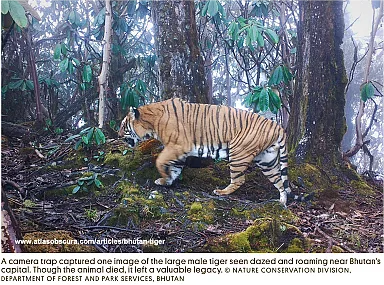
In March 2018, something unusual happened near the outskirts of Thimphu, the capital city of Bhutan. Photos emerged of a large male tiger wandering in broad daylight, unconcerned with the presence of people nearby. Such behavior alarmed wildlife officials, who then brought the animal into captivity. They feared these symptoms were caused by a disease and did their best to keep the animal alive. Unfortunately, the tiger succumbed to its affliction.
When an animal dies, veterinarians can perform a necropsy, the equivalent of an animal autopsy. These are critical to determining the cause of death. In this case, the concern was that this tiger had canine distemper virus. A highly infectious disease, canine distemper can infect not only domestic dogs, as its name suggests, but other mammalian carnivores (1,2). Infection often leads to death. Should the virus infect the central nervous system, resulting symptoms include abnormal behaviors such as loss of fear and aggression, just like the tiger in Thimphu. This worried Bhutan’s government officials, as a canine distemper outbreak within a small tiger population can have serious implications (3). In Russia, several tigers that were later diagnosed with canine distemper have been observed with the same unusual behaviors (4,5).
As veterinarians examined the deceased tiger, canine distemper was at the forefront of their minds. However, nature is full of surprises. Inside the skull sat a coin-sized blob, which was a cyst formed by the larval stage of a tapeworm (6). Turns out, the tiger did not have distemper. Although unexpected, the pieces of the puzzle fit together. Tapeworm cysts cause similar symptoms in yaks, a culturally and economically important animal in Bhutan (7). It is unknown how the tiger contracted the tapeworm, but examination revealed it was a species with a complex life cycle that relies on humans and pigs as hosts (8). This species of tapeworm also infects humans through the consumption of undercooked pork.
This story underscores the complex and unexpected relationships between disease, wildlife, and humans. Our Bhutan Wild Cat Health Project was established with our partners to identify these linkages. It starts with monitoring, not only of wild cats but also human activity and, crucially, domestic dogs. As a major reservoir for canine distemper and other diseases (1,2), monitoring domestic dogs, particularly when and where they interact with wild cats, is crucial to understanding potential risks of disease transfer. Another important component of the project is measuring the prevalence of parasites and diseases in wild cats. We do this by collecting fecal samples, bringing them to a laboratory to identify the animal species, and survey parasites and pathogens. We can also measure hormone levels, specifically cortisol, from these fecal samples, indicating whether animals have high levels of stress, which can compromise the immune system. An exciting recent development of this project is the addition of Bhutan’s first-ever K9 conservation unit to conduct fecal surveys, in partnership with the Bhutan government. Felidae and our partners are collaborating to source and train multiple free-roaming dogs as conservation detection dogs, while also training forestry rangers to care for them and deploy them in the field for multi-week fecal survey efforts.
The final component of the Bhutan Wild Cat Health Project is outreach and public awareness. Sharing the results of the monitoring project and providing educational materials to local communities and government officials is important to spread awareness about wildlife diseases. Often, though, real-world situations provide the most tangible lessons. The story of the Thimphu tiger, although tragic, serves as a dramatic reminder of how tiny organisms, like a larval tapeworm, can take down apex predators at the top of the food chain. It also emphasizes the importance of understanding disease prevalence in wild cat populations to mitigate the risk to the long-term survival of these species.
To learn more about the Felidae Conservation Fund’s Bhutan Wild Cat Health Project, visit https://felidaefund.org/projects/research/bhutan-wild-cat-health-project.
For more on the Thimphu tiger, see this story.
References
(1) Deem, S.L. et al. 2000. Canine distemper in terrestrial carnivores: A review. Journal of Zoo and Wildlife Medicine, 31(4): 441–451.
(2) Williams, E.S. 2001. Canine distemper. Infectious diseases of wild mammals, 3: 50-59.
(3) Gilbert, M., et al. 2014. Estimating the potential impact of canine distemper virus on the Amur tiger population (Panthera tigris altaica) in Russia. PLOS ONE, 10: e110811.
(4) Gilbert, M., et al., 2015. Canine distemper virus as a threat to wild tigers in Russia and across their range. Integrative Zoology, 10: 329-343.
(5) Seimon, T.A., et al. 2013. Canine distemper virus: An emerging disease in wild tigers. mBio, 4: e00410-13.
(6) Phuentshok, Y., et al. 2021. Cerebral cysticercosis in a wild Bengal tiger (Panthera tigris tigris) in Bhutan: A first report in non-domestic felids. International Journal for Parasitology: Parasites and Wildlife, 14: 150–156.
(7) RangaRao, G.S.C. and Sharma, R.L., 1994. Parasitic infections of Indian yak Bos (poephagus) grunniens—An overview. Veterinary Parasitology, 53: 75-82.Taenia saginata & Taenia solium. 2023. Encyclopedia of Food Safety, 2nd Volume 2. Editor: Santiago-Connolly, L.M. Elsevier Inc.
Do You Have 2-4 Hours A Month To Preserve Your Local Ecosystem?
Our volunteers are the driving force behind making true change in ecosystem health and wild cat conservation. Some like to volunteer in the field, others help us maintain our online presence, and some work with events. With just a few hours a month, you can make a difference, too.
Make A Difference Right Now
As a 501(c)3 nonprofit, our work is only possible because of generous donors like you.
More than 93% of your donation will go directly to our groundbreaking research, outreach, and education programs.
This is where true change starts. If you’d like to be a part of it, make a donation to Felidae Conservation Fund today:
Or,